
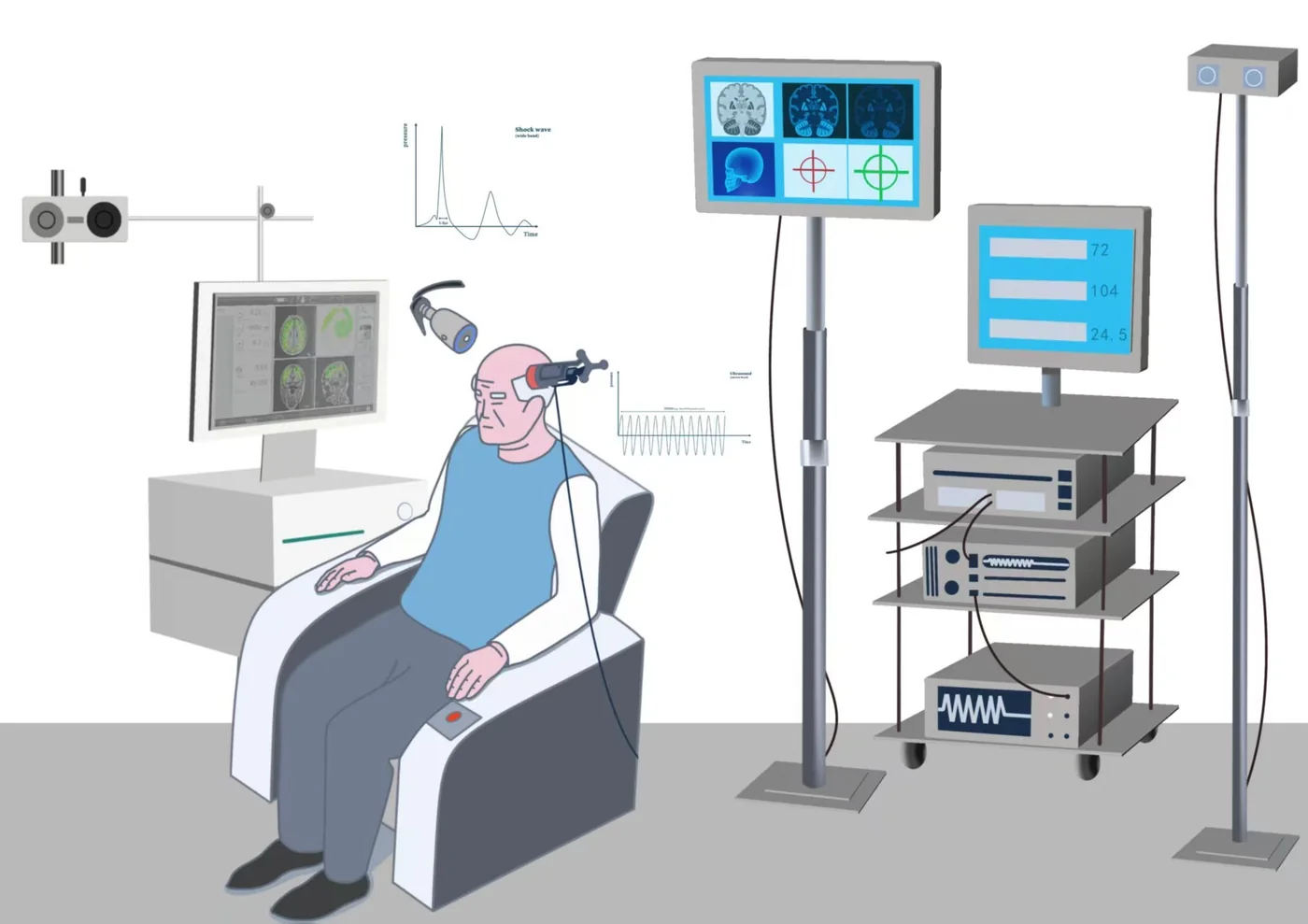
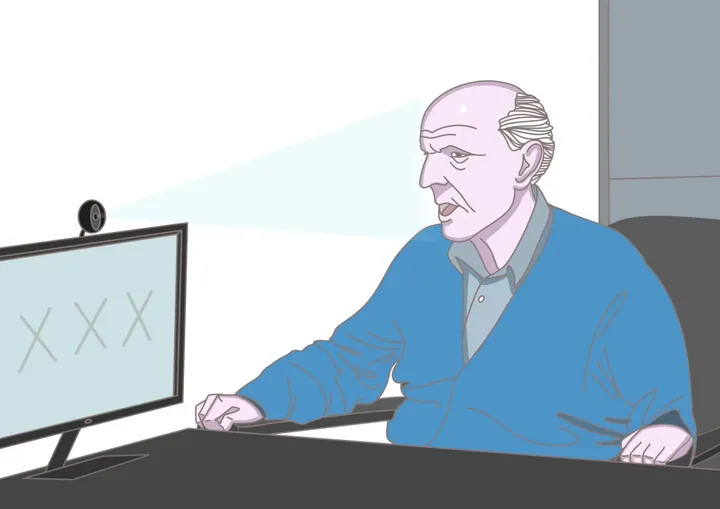
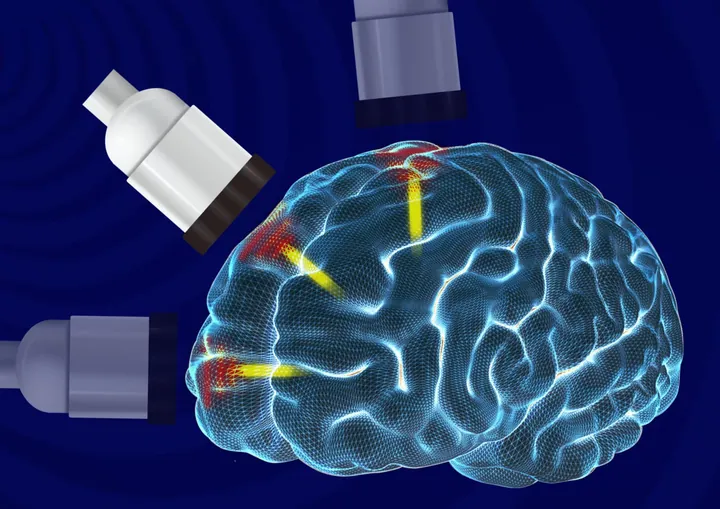
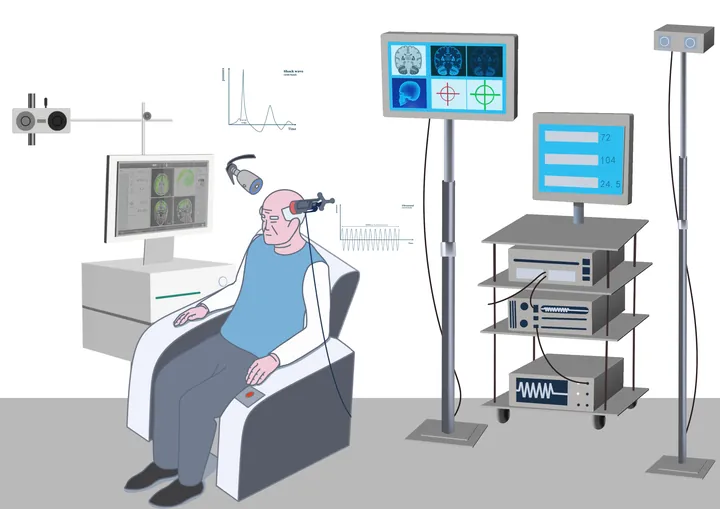
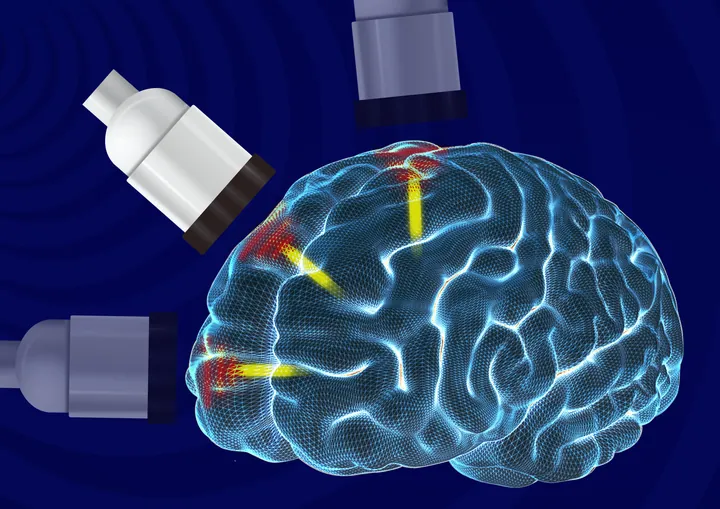
围绕经颅/深部磁刺激(TMS)的主题插画组:治疗椅场景、线圈与大脑的位置关系、治疗室环境与 3D 刺激示意。与团队深部磁刺激研究的主题相关;按现有构图分别归档,不推定版本先后或作者取舍。
图背后的故事
引言:睡眠剥夺(SD)显著扰乱心脑轴的稳态,而深部磁刺激(DMS)作为一种无创、安全的方法,其神经调控作用仍不清楚。方法:招募 60 名健康成年男性进行 36 小时睡眠剥夺研究,按个人意愿分入 DMS 组或对照组;所有人在实验起点与终点接受心音测量和功能磁共振成像扫描。恢复睡眠阶段,DMS 组在入睡前与醒来时各接受一次 30 分钟深部磁刺激。研究用双因素分析揭示状态变化与组间干预效应,用 Spearman 秩相关评估脑活动与心活动的关联,用线性回归探索 DMS 经脑区调节心活动的效应,并用自助法(bootstrap)检验中介效应。结果:DMS 组心动周期时长为 0.81±0.04 秒,对照组为 0.80±0.03 秒,DMS 呈延长效应(F=0.32,p=0.02),且 DMS 组各项心率与强度指标值均低于对照组(p<0.01)。双因素分析显示左侧脑岛与眶额下回差异显著,DMS 后其 DC_Weight(0.25)值分别低于 0.50(p<0.01)与 0.42(p<0.01)。相关分析证实左眶额下回、左脑岛与心音指标呈负相关(p<0.05):Δ左眶额下回与 Δ收缩期强度(rho=−0.33)、Δ舒张期强度(rho=−0.41)、ΔS1 强度(rho=−0.36)、ΔS2 强度(rho=−0.43)负相关;Δ左脑岛与 Δ舒张期强度(rho=−0.36)、ΔS1 强度(rho=−0.33)、ΔS2 强度(rho=−0.36)负相关。中介效应分析显示 DMS 通过干预脑区影响 S2 强度。结论:以上发现提示 36 小时睡眠剥夺后心脑轴存在因果效应;DMS 的无创干预可有效调节睡眠剥夺后的脑与心功能、促进稳态平衡。DMS 能够影响心脑轴,为长时间睡眠剥夺后的恢复提供了一种手段。
论文摘要(中文译文 · 原文)
中文译文 引言 睡眠剥夺(SD)会显著破坏心脑轴的稳态,而深部磁刺激(DMS)这一无创、安全的神经调控方法对其影响仍知之甚少。方法 研究招募60名健康成年男性进行36小时睡眠剥夺,按个人意愿分配至DMS组或对照组;所有受试者在实验起点与终点接受心音测量和功能磁共振成像(fMRI)扫描。恢复睡眠阶段,DMS组在入睡前与觉醒时各接受一次30分钟刺激。采用双因素分析揭示两组在两种状态下的变化与干预效应,以Spearman等级相关分析评估脑活动与心脏活动的相关性,用线性回归分析探讨DMS对调控心脏活动的脑区的影响,并以自助法(bootstrapping)验证中介效应。结果 DMS组心动周期时长为0.81 ± 0.04 s,对照组为0.80 ± 0.03 s,DMS呈延长效应(F = 0.32,p = 0.02),且各项心音频率与强度指标均低于对照组(p < 0.01)。双因素分析显示左侧脑岛与眶部额下回差异显著,DMS后 DC_Weight(0.25)值分别降低0.50(p < 0.01)与0.42(p < 0.01)。相关分析证实左侧眶部额下回、左侧脑岛与心音指标呈负相关(p < 0.05):Δ左侧眶部额下回与Δ收缩期强度(rho = −0.33)、Δ舒张期强度(rho = −0.41)、Δ S1强度(rho = −0.36)、Δ S2强度(rho = −0.43)负相关(均p < 0.05);Δ左侧脑岛与Δ舒张期强度(rho = −0.36)、Δ S1强度(rho = −0.33)、Δ S2强度(rho = −0.36)负相关。中介效应分析表明,DMS通过作用于脑区影响S2强度。结论 这些发现提示36小时睡眠剥夺后心脑轴存在因果效应;DMS无创干预可有效调节睡眠剥夺后的脑与心功能、促进稳态平衡,为长时间睡眠剥夺后的平衡恢复提供了一种手段。
Introduction Sleep deprivation (SD) significantly disrupts the homeostasis of the cardiac-brain axis, yet the neuromodulation effects of deep magnetic stimulation (DMS), a non-invasive and safe method, remain poorly understood. Methods Sixty healthy adult males were recruited for a 36-h SD study, they were assigned to the DMS group or the control group according to their individual willing. All individuals underwent heart sound measurements and functional magnetic resonance imaging scans at the experiment's onset and terminal points. During the recovery sleep phase, DMS was applied twice for 30 min before sleep onset and upon awakening to the individuals in the DMS group. Two-factor analysis was used to disclose the changes in two status and intervention effect in groups, along with Spearman rank correlation analysis to assess the correlation between brain activity and heart activity, the linear regression analysis was performed to explore the effect of DMS on brain regions to regulated the heart activity. Additionally, bootstrapping analysis was employed to verify the mediation effect. Results The results indicated that the DMS group cardiac cycle duration was 0.81 ± 0.04 s, CON group was 0.80 ± 0.03 s, DMS presented a prolong effect ( F = 0.32, p = 0.02), and all heart frequency and intensity indexes value were lower than CON group ( p < 0.01). Two-factor analysis demonstrated the significant differences in the left insula and orbitofrontal inferior gyrus, which DC_Weight (0.25) value were lower 0.50 ( p < 0.01), 0.42 ( p < 0.01) after DMS. Furthermore, the correlation analysis confirmed that the negative association between the left orbital inferior frontal and left insula with the heart sound index ( p < 0.05), such as Δ left orbital inferior frontal were negatively correlated with Δ Systolic_intensity (rho = −0.33, p < 0.05), Δ Diastolic_intensity (rho = −0.41, p < 0.05), Δ S1_intensity (rho = −0.36, p < 0.05), and Δ S2_intensity (rho = −0.43, p < 0.05). Δ Left insula was negatively correlated with Δ Diastolic_intensity (rho = −0.36, p < 0.05), Δ S1_intensity (rho = −0.33, p < 0.05), and Δ S2_intensity (rho = −0.36, p < 0.05). Mediated effect analysis showed that DMS affected S2_intensity by intervening in brain regions. Conclusion These findings suggest a causal effect on the cardiac-brain axis following 36 h of SD. The non-invasive intervention of DMS effectively regulates both brain and heart functions after SD, promoting homeostatic balance. The DMS can affect the cardiac-brain axis, offering a means to restore balance following extended periods of SD.