
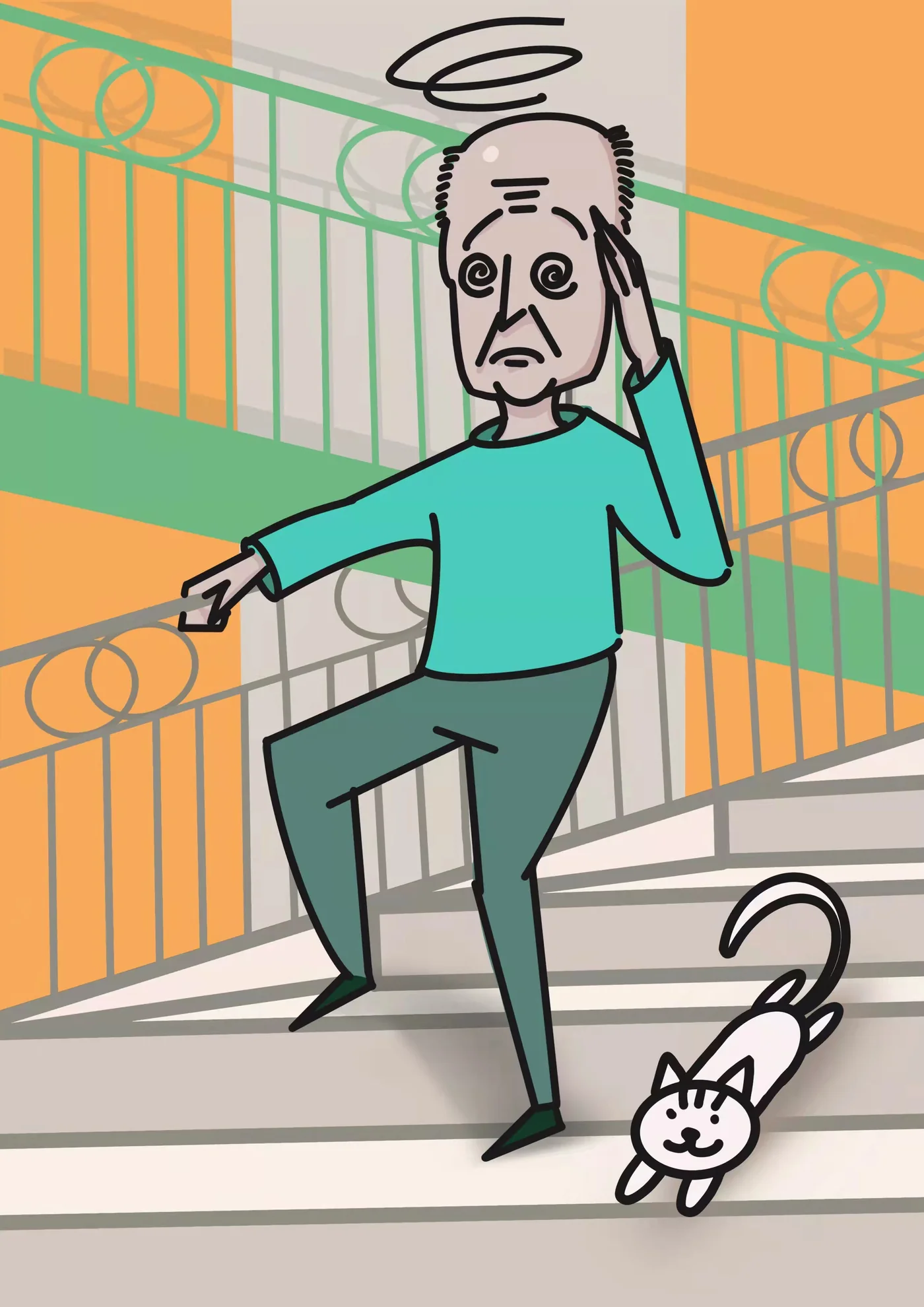
The moment an elder climbs stairs with a rail: one hand on the rail, one on the knee, fully focused, a white cat looking back at his feet. Simple lines carrying themes of balance and safety in later life — with a note of companionship.
The Story Behind the Image
Paper abstract (original)
Abstract Objectives To estimate the prevalence of depression symptoms and quality of life (QoL) and examined the influence of factors in the empty nest elderly. Methods This was a cross-sectional study, which was conducted from February 2022 to May 2022. We recruited a convenience sample of no empty-nest elderly and empty-nest elderly (≥60 years) living in Chengdu. QoL was assessed using WHOQOL-BREF, Geriatric Depression Scale (GDS-15) was used to assess depression symptoms. Multivariable logistic regression was used to analyze data between independent variables with depression symptoms. Results Two thousand twenty-six participants were included in this study, 39.0% (660/1,082) experienced depression symptoms among empty-nest elderly. Age (aOR, 1.02; 95% CI, 1.00–1.04; P = 0.046), chronic disease≥2 (aOR, 3.29; 95% CI, 2.50–4.33; P < 0.001) were associated with increased risk of depression symptoms, and physical activity (aOR, 0.59; 95% CI, 0.40–0.87; P = 0.008), physical health (aOR, 0.93; 95% CI, 0.88–0.99; P = 0.026), psychological health (aOR, 0.93; 95% CI, 0.87–0.98; P = 0.013), and total score (aOR, 0.97; 95% CI, 0.96–0.99; P < 0.001) were associated with decreased risk of depression symptoms among empty-nest elderly. Conclusions Depression symptoms are common mental health problems among empty-nest elderly. We found that age, chronic disease ≥2 and physical activity were important factors that have an impact on depressive symptoms. Empty-nest elderly would have lowered QoL score. Keywords: empty-nest elderly, quality of life, depression, mental health, WHOQOL-BREF