
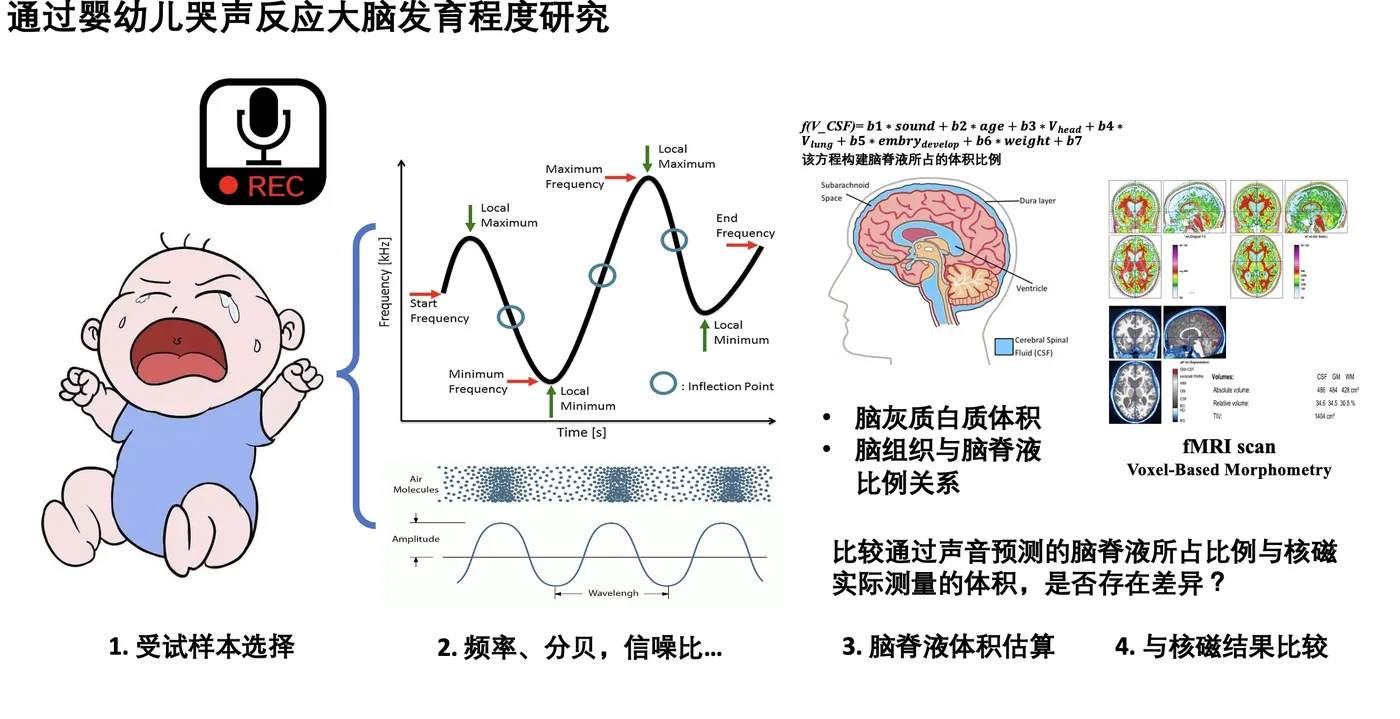
Ein Flussbild entwirft die Studie: Akustikmerkmale des Säuglingsschreis werden mit MRT-Maßen abgeglichen. Eine stumme Schleife von etwa 3 Sekunden zeichnet den Weg „Schrei — Analyse — Abgleich“ nach. Das Team hat eine Methodenarbeit zur automatischen Schrei-Segmentierung sowie einen narrativen Review zum Säuglingsschrei publiziert.
Die Geschichte hinter dem Bild
Abstract (Originalfassung)
Infant crying conveys abundant information, including neurophysiological, pathological, and psychological aspects. However, the relationship between crying and brain structure remains poorly understood. In this study, 154 preterm infants and 84 term infants were enrolled, and their cries were recorded for 1 min under similar stimulation conditions. MATLAB software was used to analyse the crying data, for statistical analyses, repeated cry-level observations were averaged within infant, and each infant contributed one value for each cry acoustic parameter. Magnetic resonance imaging (MRI) was performed in 43 preterm infants to measure the volumes of grey matter, white matter, and cerebrospinal fluid (CSF). Preterm infants had longer cry cycle and inhale durations than term infants (P = 0.022 and 0.014). Among preterm infants, cry parameters did not differ significantly across gestational ages (all P > 0.05). In 43 preterm infants with MRI, grey and white matter volumes differed significantly across gestational age groups (P = 0.01 and 0.02), as did the grey matter/CSF and white matter/CSF ratios (P = 0.010 and 0.020). Correlations between cry parameters and brain volumes were generally weak. Multiple linear regression showed that cry parameters were associated with white matter volume (R2 = 0.38, P = 0.039) but not with grey matter or CSF volume. This study identified associations between cry characteristics and MRI-derived brain volumes in infants across gestational ages. Although these findings suggest that cry characteristics may reflect certain aspects of brain development, the observed associations were generally weak and should be considered exploratory.