
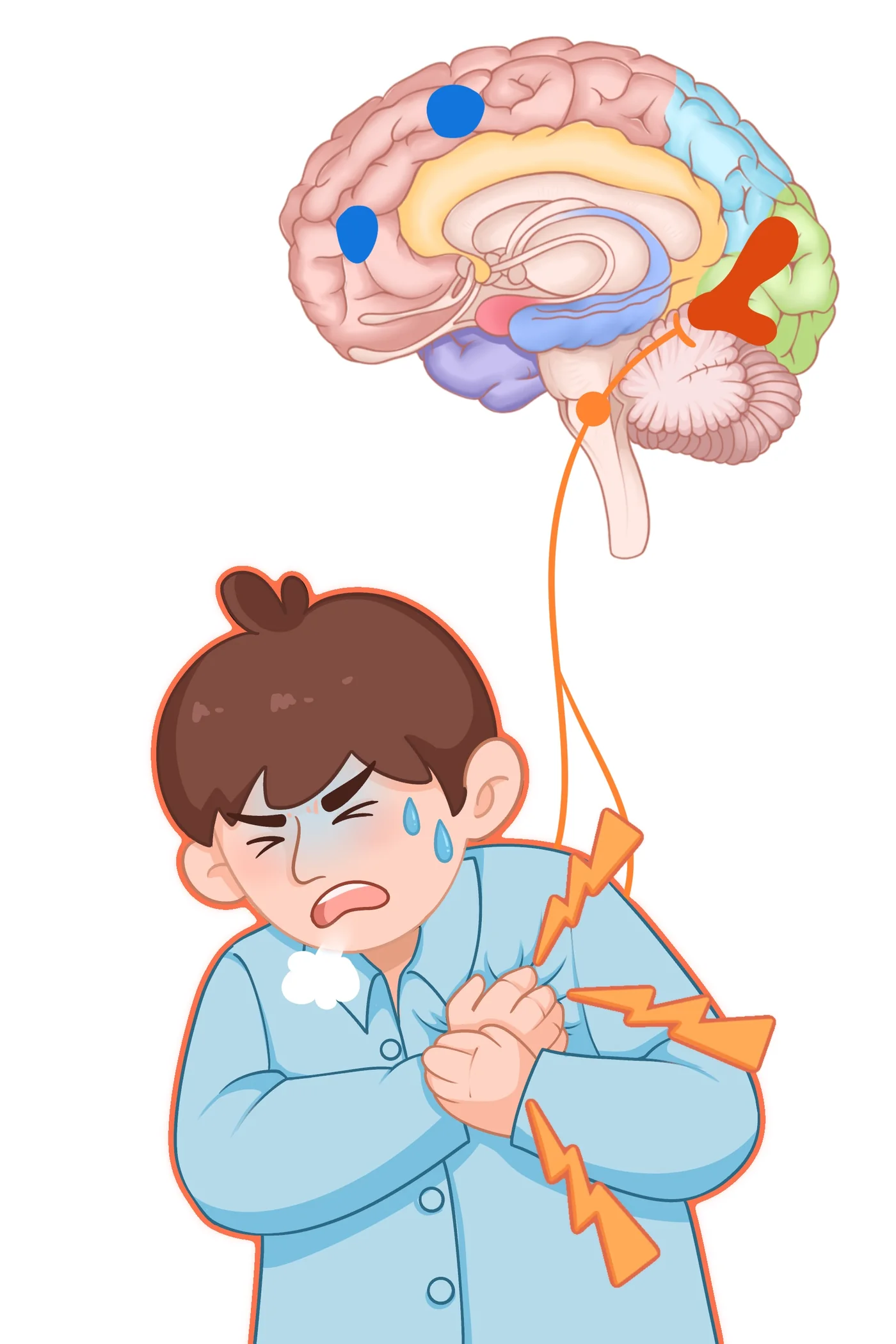
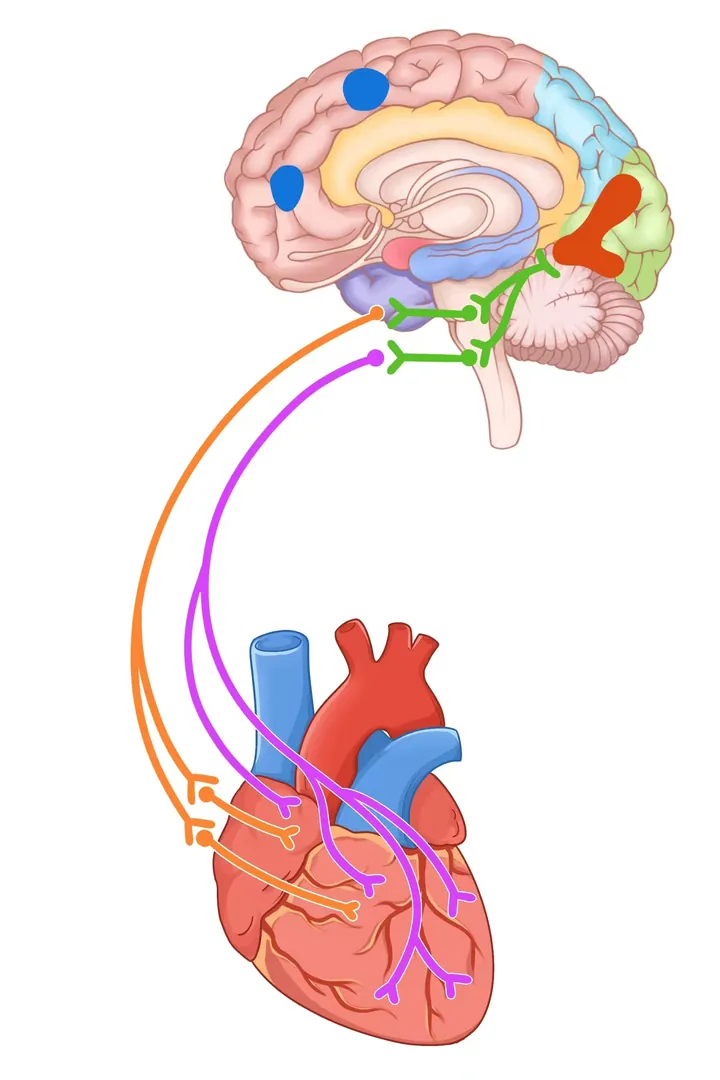
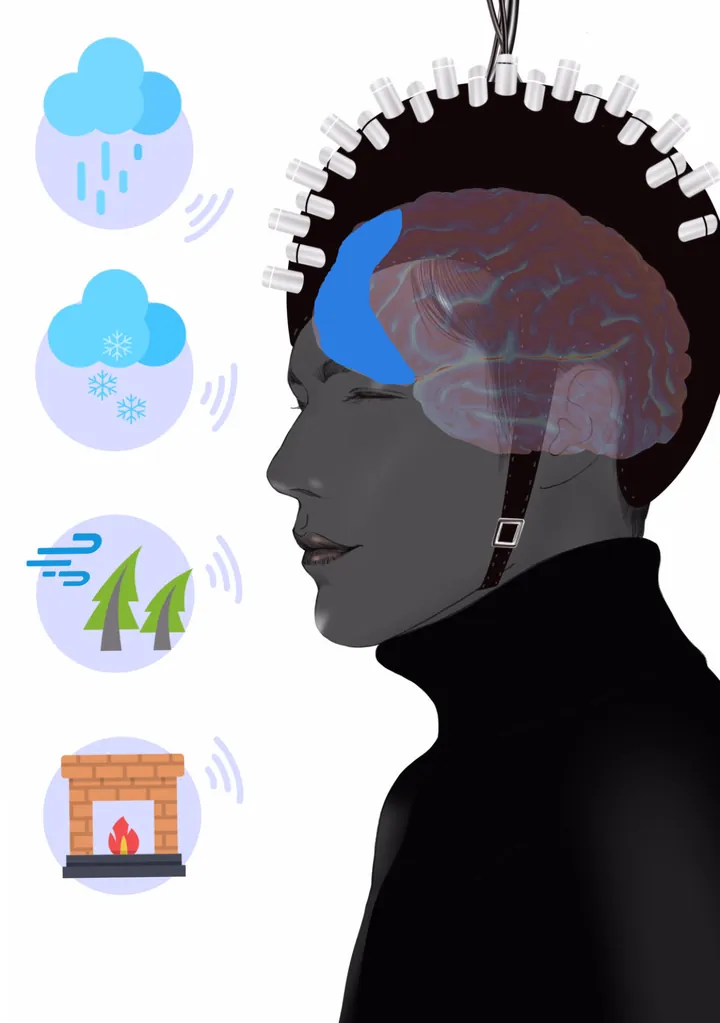
情緒如何被看見?一組插畫給出兩種答案:其一直接呈現情緒狀態下的腦活動擬人表達;其二把情緒比作天氣——頭部剪影中的晴雨圖標隨狀態變化。適合心理健康主題的科普引入。
圖背後的故事
背景:白噪聲因其對心理和生理狀態的潛在作用(尤其是促進放鬆)而受到廣泛關注。前額葉皮層是負責高級認知功能與情緒調節的關鍵腦區,其對外界刺激的反應可能影響個體的身心健康。儘管已有研究考察白噪聲的鎮靜作用,但針對其影響前額葉皮層活動的系統研究仍然缺乏。本研究旨在探討白噪聲對前額葉皮層的鎮靜作用及相關生理機制。方法:共招募 103 名健康大學生,隨機分爲四組(爐火 n=24、風 n=27、雨 n=27、雪 n=25),每組暴露於對應白噪聲 3 分鐘。採用功能近紅外光譜(fNIRS)評估腦興奮性變化,同時測量生命體徵與面部表情的變化。結果:fNIRS 數據經配對樣本 t 檢驗分析:在風組與雪組中,白噪聲可有效降低相關腦區的皮層興奮性;興奮性降低的區域集中在額極部的額前皮層與 Broca 區三角部,兩個區域的氧合血紅蛋白濃度分別從 −0.159 降至 −0.107 µmol/L、從 −0.139 降至 −0.096 µmol/L,二者均參與放鬆與鎮靜調節。結論:白噪聲可降低前額葉皮層的興奮性併發揮鎮靜作用,有助於加深對白噪聲參與神經調控方式的理解。
論文證據
Figure 4 · derivative(同底稿的論文編輯版)
Sedative Effect of White Noise on Prefrontal Cortex Lobe: A Randomized Controlled Study Based on Functional Near-Infrared Spectroscopy
論文摘要譯文(本站譯,忠實原文)
背景:白噪聲因其對心理和生理狀態的潛在作用(尤其是促進放鬆)而受到廣泛關注。前額葉皮層是負責高級認知功能與情緒調節的關鍵腦區,其對外界刺激的反應可能影響個體的身心健康。儘管已有研究考察白噪聲的鎮靜作用,但針對其影響前額葉皮層活動的系統研究仍然缺乏。本研究旨在探討白噪聲對前額葉皮層的鎮靜作用及相關生理機制。方法:共招募 103 名健康大學生,隨機分爲四組(爐火 n=24、風 n=27、雨 n=27、雪 n=25),每組暴露於對應白噪聲 3 分鐘。採用功能近紅外光譜(fNIRS)評估腦興奮性變化,同時測量生命體徵與面部表情的變化。結果:fNIRS 數據經配對樣本 t 檢驗分析:在風組與雪組中,白噪聲可有效降低相關腦區的皮層興奮性;興奮性降低的區域集中在額極部的額前皮層與 Broca 區三角部,兩個區域的氧合血紅蛋白濃度分別從 −0.159 降至 −0.107 µmol/L、從 −0.139 降至 −0.096 µmol/L,二者均參與放鬆與鎮靜調節。結論:白噪聲可降低前額葉皮層的興奮性併發揮鎮靜作用,有助於加深對白噪聲參與神經調控方式的理解。
文章摘要(中文譯文 · 原文照錄)
中文譯文 背景:白噪聲因其對心理與生理狀態的潛在影響而受到廣泛關注,尤其在促進放鬆方面。前額葉皮質是負責高級認知功能與情緒調節的關鍵腦區,可能通過對外界刺激的反應影響個體身心健康。既往研究已考察白噪聲的鎮靜效果,但對其如何具體影響前額葉皮質活動的系統研究仍然缺乏。本研究旨在探索白噪聲對前額葉皮質的鎮靜作用,闡明其相關生理機制。方法:共招募103名健康成年大學生,隨機分爲四組(篝火聲 n = 24;風聲 n = 27;雨聲 n = 27;雪聲 n = 25),各組暴露於相應白噪聲3分鐘;採用功能近紅外光譜(fNIRS)評估腦興奮性變化,並測量生命體徵與面部表情變化。結果:fNIRS 數據採用配對樣本 t 檢驗分析;風聲組與雪聲組中,白噪聲可有效降低相關腦區的皮質興奮性,興奮性降低的區域集中在前額葉皮質與布羅卡區前額極三角部,兩區氧合血紅蛋白濃度分別由 −0.159 降至 −0.107 µmol/L、由 −0.139 降至 −0.096 µmol/L,均參與放鬆與鎮靜調節。結論:白噪聲可降低前額葉皮質興奮性併發揮鎮靜作用,有助於深化對白噪聲參與神經調控機制的理解。
Background: White noise has attracted widespread attention due to its potential effects on psychological and physiological states, particularly in promoting relaxation. The prefrontal cortex, a critical region of the brain responsible for higher cognitive functions and emotional regulation, may influence an individual's mental and physical health through its responses to external stimuli. Although previous research has investigated the calming effects of white noise, systematic studies on its specific impact on prefrontal cortex activity are still lacking. This study aims to explore the calming effects of white noise on the prefrontal cortex to elucidate its associated physiological mechanisms. Methods: In total, 103 healthy adult college students were recruited and randomly divided into four groups (fire, n = 24; wind, n = 27; rain, n = 27; and snow, n = 25), with each group exposed to the corresponding white noise for 3 min. Functional near-infrared spectroscopy (fNIRS) was used to evaluate excitability changes in the brain and changes in life signs and facial expressions were also measured. Results: The data of fNIRS were analyzed by paired sample t-test; in the wind group and the snow group, we found that the white noise can be effectively decreased the cortical excitability of related brain areas. The areas of reduced excitability were concentrated in the prefrontal cortex and pars triangularis of Broca's frontopolar area, while the concentration of oxyhemoglobin in these two area decreased from −0.159 to −0.107 µmol/L and from −0.139 to −0.096 µmol/L, respectively, both areas involved in relaxing and sedative modulation. Conclusion: White noise can reduce the excitability of the prefrontal cortex and play a sedative effect. It may strengthen our understanding of how white noise is involved in neural modulation.
匹配說明:作品圖 F088(情緒與腦插畫)同作品變體;人物、帽與雨雪風爐火圖標一致,額葉藍區與比例有改動,見論文 Figure 4。
doi.org/10.4103/nah.nah_88_24 · PubMed 40029675 · PMC 全文
繪圖:Xiaofeng Jing(據論文 Author contributions);作品權利經公司負責人 2026-10-20 確認爲公司自有。
論文許可:CC BY-NC-SA 4.0(第三方再利用論文版圖須署名並以相同方式共享)。作品權利:公司負責人 2026-10-20 確認本作品爲公司自有創作,官網展示無授權風險;論文版繪圖貢獻聲明歸於 Xiaofeng Jing。 查看許可